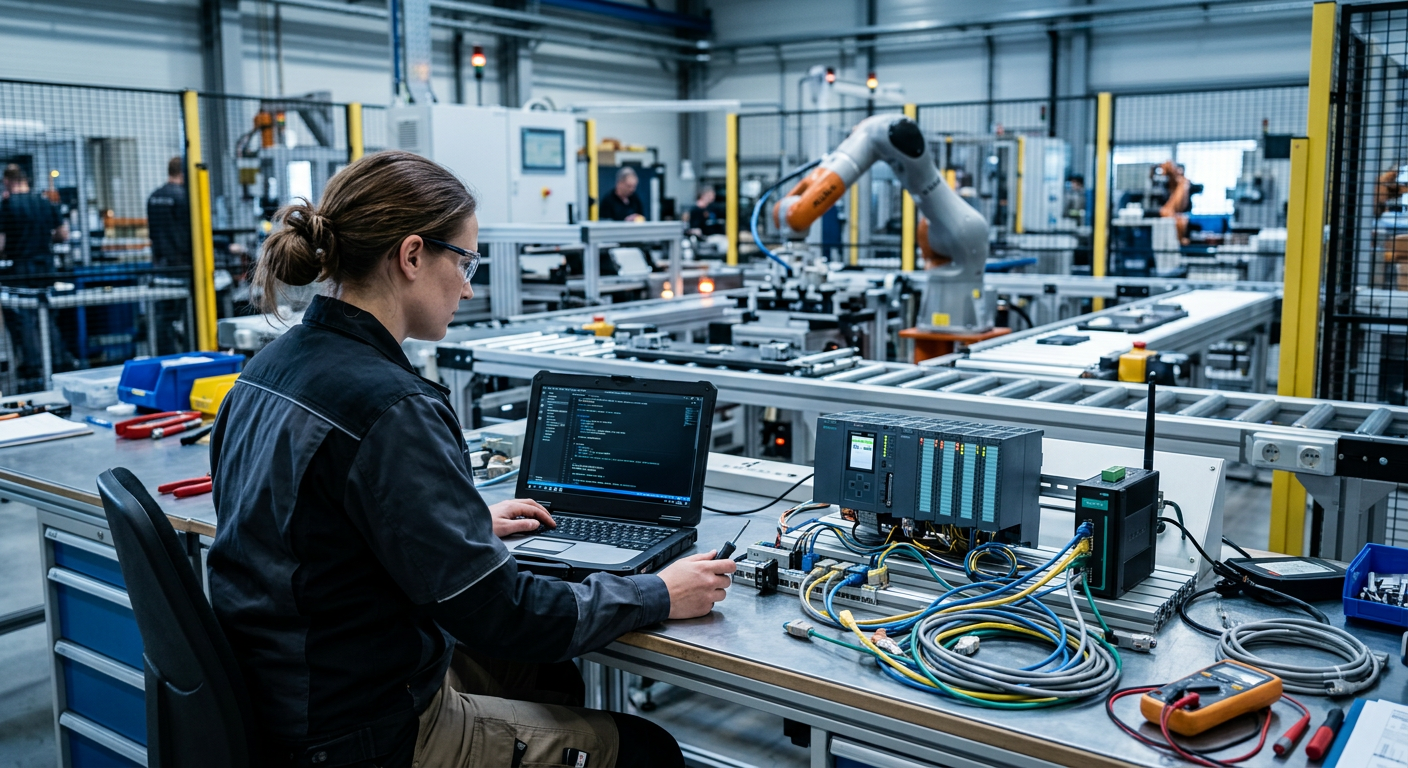
Programs and communication prototypes for machines – ACORE, Silesia
Gliwice, Rybnik, Knurów and surroundings within 50 km – from idea to working integration
Most searched topics:
Quick answer
Machine integration means that equipment from different manufacturers starts exchanging data with each other and with ERP, MES and databases. The safest way to begin is a small prototype (proof of concept) on one machine: we verify the protocol, the data scope and latencies before a decision is made to roll it out across the line. ACORE from Knurów writes programs for PLCs, gateways and middleware services, builds test benches and also repairs the hardware the whole solution runs on. We serve Gliwice, Rybnik and the surrounding area within about 50 km, and take orders from all over Poland and abroad. Quotations are individual and free after an initial analysis.
Why manufacturers increasingly look for machine integration and custom software
A typical plant in Silesia has a machine park built up over years: a press from the nineties, a new packing line, a robot bought with a subsidised project, a scale with a label printer and several controllers from different brands. Each of these devices works on its own and is often the only source of information about its own operation. Production data reaches the shift supervisor on paper, in Excel or not at all.
When order volumes grow, customers expect batch traceability and accounting wants to know the real cost of a product, manual re-typing is no longer enough. This is when a program is needed that connects machines with each other and with IT systems. An off-the-shelf package rarely fits equipment from different decades and manufacturers, which is why software is tailored to a specific machine park.
Our core is hardware: repairs of controllers, drives, HMI panels, power supplies and communication cards. That is why the programs we write are designed for real shop-floor conditions: interference, long cables, old serial interfaces and missing documentation. We know these devices down to the circuit board, which speeds up diagnosis when communication simply will not start.
What problems companies struggle with – the most common integration barriers
Conversations with maintenance departments and production managers, together with industry publications, show that the barriers have been the same for years. The table below lists those we meet most often, together with the way we solve them.
| Problem | Consequence for the company | How we solve it |
|---|---|---|
| Machines from different manufacturers do not speak the same protocol | No single view of production, manual data collection | Protocol gateway or middleware translating data into a common format (OPC UA, MQTT, SQL) |
| An older machine has no communication port | Data unavailable without replacing the whole machine | Non-invasive retrofit: input modules, sensors, current transformers, edge gateway |
| The manufacturer's protocol is closed or undocumented | Dependence on the vendor's service, no way to extend | Line traffic analysis, frame reconstruction, own protocol driver and bench tests |
| Data lives in Excel and on paper | Typing errors, delayed reports, no batch tracking | Automatic logging of events and counters to an SQL database, integration with ERP or MES |
| No time for downtime and trials on a running line | Fear of every change, projects postponed | Prototype on a test bench, staged rollout, pilot on one machine |
| No documentation and no author of the PLC program | Nobody knows what may be changed, risk of failure after every modification | Project backup, variable clean-up, signal documentation and communication diagrams |
| Cybersecurity concerns after connecting machines to the network | IT department blocks projects | Network segmentation, no direct internet access, authenticated connections, least privilege |
| Uncertainty whether the investment will pay off | Projects put off for later | A small prototype with a measurable result (e.g. automatic piece and downtime counter) as the first step |
The most common mistake
Companies try to integrate the entire plant at once. It is far more effective to pick one machine or one bottleneck, build a prototype, show the result and only then scale the solution to further equipment.
What we write and build – the scope of programs and communication prototypes
The term "machine integration" hides several layers of work. In practice we combine them into one project, but it is worth distinguishing them, because each requires different skills and tools.
- PLC programs: data exchange logic, buffers, acknowledgements, error handling and communication recovery after power loss,
- protocol drivers for devices with a serial interface: scales, label printers, code readers, meters, older controllers,
- middleware on an industrial PC or edge gateway that reads data from machines and publishes it further,
- connections to SQL databases, ERP, MES and WMS systems: orders, counters, statuses, quality results,
- machine-to-machine signals: readiness acknowledgements, passing products between stations, robot cooperation with a conveyor and a vision system,
- dashboards and reports: simple panels for the shift supervisor, e-mail or SMS alarms, export to CSV and XML,
- test benches and machine simulators that let you check a program without stopping production.
For larger projects that need full process visualisation, we connect our solutions to the supervisory systems described in a separate article on machine integration with SCADA. This text focuses on the earlier layer: how the communication itself is created and how to verify it safely.
Why start with a prototype (proof of concept)
A communication prototype is a small, quickly built setup that proves that data from a specific machine can be read, processed and passed on. It is not a show version but the first stage of the real project, which removes its biggest risks.
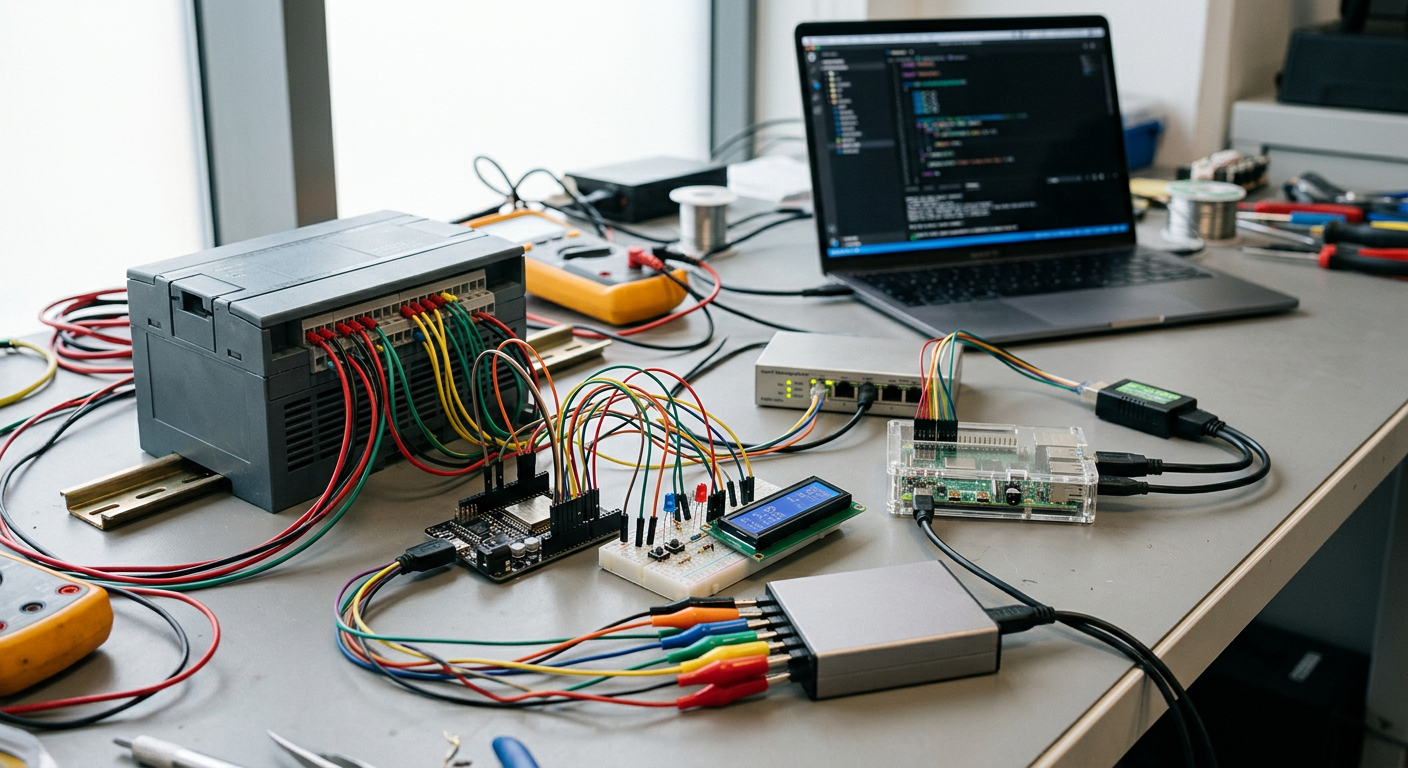
A prototype answers questions that cannot be settled on paper: does the machine really send data the way the documentation says, how often does it refresh values, is the link immune to interference from drives, do latencies meet process requirements, and does machine safety remain untouched.
- Conversation and initial analysis: list of machines, controller brands, data scope, business goal and places where information is lost today.
- Interface survey: checking ports, protocols, addresses and documentation or, when missing, analysing traffic on the link.
- Building a test bench: recreating the communication on a table, with a machine simulation or a removed device.
- Software prototype: reading, writing, error handling, event logging and first results in a simple view.
- Trial on the machine during an agreed service window, without interfering with safety circuits.
- Review of results with the customer and a decision: develop, change approach or stop at this stage.
Thanks to this we know how much the rollout really costs and how long it will take before the customer commits a larger budget. The quotation for the full project is then based on verified facts instead of assumptions.
Tools and technologies – what we use
We do not impose a single technology. We choose tools to match what already works at the customer, so that after the project the maintenance department can understand and operate the solution on its own.
| Layer | Example technologies | Purpose |
|---|---|---|
| PLC controllers | Siemens TIA Portal, Codesys, Mitsubishi GX Works, Omron Sysmac, Beckhoff TwinCAT, Studio 5000, IEC 61131-3 languages | Data exchange logic right at the machine, event and alarm handling |
| Microcontrollers and prototype boards | ESP32, STM32, Arduino, Raspberry Pi | Fast prototypes, gateways for simple devices, signal readers, converters |
| Interfaces | RS-232, RS-485, CAN, Ethernet, digital and analog I/O, 4–20 mA current loop | Physical connection to older and newer equipment |
| Protocols | Modbus RTU/TCP, OPC UA, MQTT, PROFINET, EtherNet/IP, vendor protocols (e.g. S7, FINS, MC), custom ASCII frames | Data exchange between machines, gateways and supervisory systems |
| Middleware | Python, C# and .NET, Node.js, Node-RED, background services | Reading from machines, processing, buffering and publishing data |
| Data and integrations | SQL (PostgreSQL, SQL Server, MariaDB), REST API, CSV and XML files, message queues | Event logging, connection to ERP, MES and WMS, reports |
| Views and reports | Web panels, Grafana, simple desktop applications, e-mail reports | Information for the shift supervisor and maintenance |
Old interfaces and closed protocols – how we approach machines without documentation
The largest group of orders are machines that communicate over a serial link or a proprietary, undocumented protocol, whose manufacturer no longer exists or no longer supports the device. Such a machine is not lost for integration.
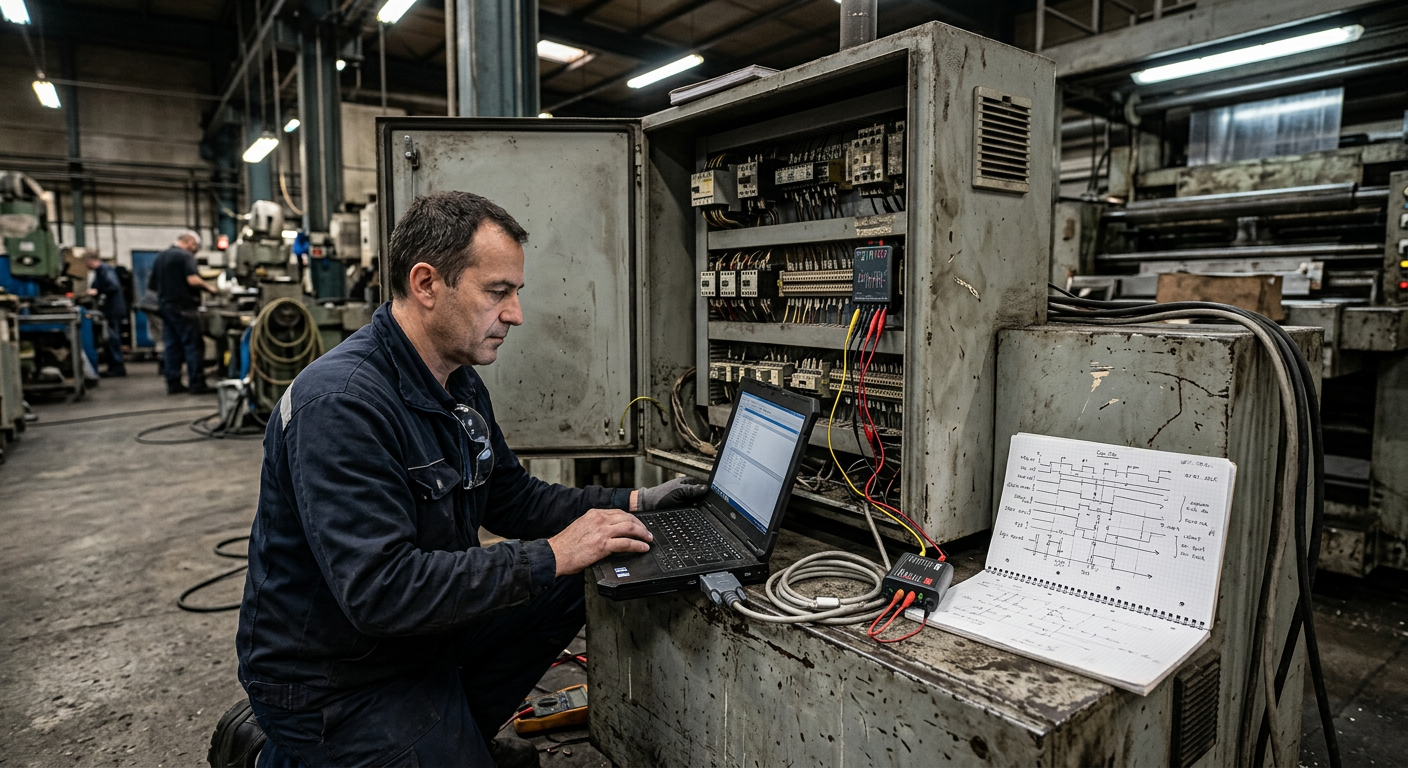
- we record traffic on the link during normal machine operation (passive listening, no influence on the process),
- we compare frames with operator actions and display changes to infer the meaning of fields, checksums and markers,
- we recreate the communication on the bench with our own program and check the device's responses,
- only after confirming correctness do we connect the solution permanently and document the frames,
- if the interface itself is damaged, we repair the communication card or transceiver at component level.
| Device type | Typical interface | Common problem | Solution |
|---|---|---|---|
| Industrial scale | RS-232 or RS-485, ASCII frames | Frames with different end-of-line markers, unstable reading | Custom parser, filtering, confirmation of result stability |
| Label printer | Ethernet, USB, serial port, label language | Template change requires an operator | Automatic sending of templates with order data |
| Inverter and drive | Modbus RTU, PROFINET, EtherNet/IP | Interference, missing RS-485 termination, wrong register mapping | Wiring correction, register map, response checking |
| Older press or packing machine | No port, only 24 V signals | No digital data at all | Input modules, cycle counters, current transformers, edge gateway |
| Robot and conveyor | I/O signals, PROFINET, vendor protocols | No synchronisation, timing collisions | State machine in PLC, two-way acknowledgements, timeouts |
| Code reader and camera | Ethernet TCP, RS-232 | Duplicate reads, no link to the order number | Program linking the read to order context and database entry |
From machine to ERP and MES – how data travels across the plant
Communication with a machine alone gives no value until the data reaches those who need it. The most common scenarios are automatic reporting of piece counts from the machine to the production order, downloading process parameters from the system to the machine, and logging downtime with its cause.
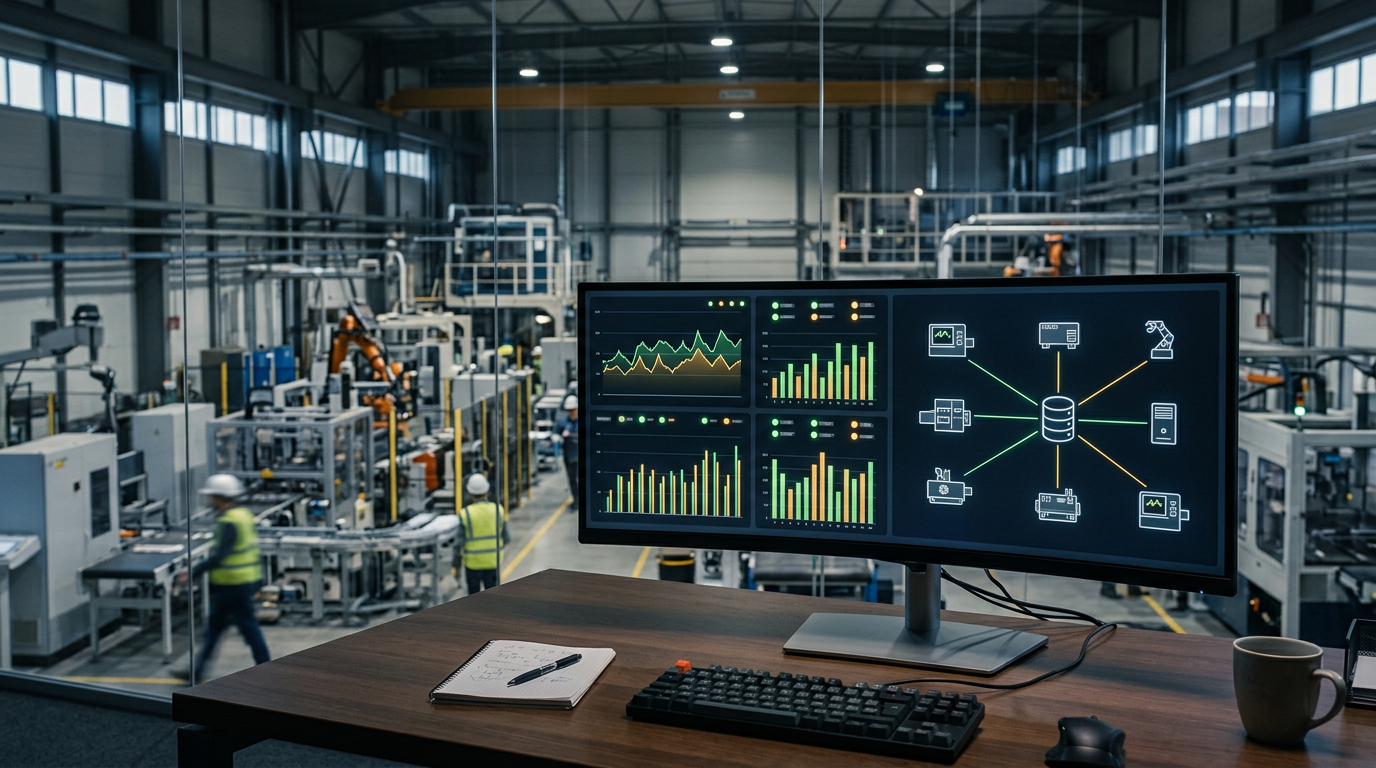
- an order from ERP goes to the machine: product index, quantity, recipe or machining program,
- the machine returns to ERP: good and bad pieces, run time, downtime, batch number,
- quality events from readers and cameras are linked to the order number and stored in the database,
- alarms and parameter excursions are sent by e-mail or SMS to the right person,
- energy and material consumption is recorded per order, allowing the real product cost to be calculated.
We integrate with the customer's existing systems through their official interfaces: databases, APIs, exchange files or dedicated modules. We do not assume replacing the ERP or MES: we work with what the company already has and uses daily.
Example integration scenarios for plants in the region
The scenarios below are typical tasks for companies in our region. They show the scale and nature of the work and do not describe a specific customer.
| Scenario | Scope of work | Result for the company |
|---|---|---|
| Piece and downtime counter on an old press | Input module, cycle signals, edge gateway, SQL logging, simple report | Performance data without replacing the machine, a basis for maintenance planning |
| Scale and printer linked to a production order | Program reading the scale, fetching order data from ERP and printing labels | No manual re-typing, fewer label and batch errors |
| Two machines from different manufacturers pass a product to each other | PLC state machine, readiness acknowledgements, error and timeout handling | Smooth product flow, no collisions, shorter cycle time |
| A CNC machine park reports to one system | Reading counters, status and alarms, unifying data from different controls | One view of machine tool operation and a downtime summary |
| Robotic station with a camera and code reader | Robot – camera – PLC data exchange, result logging, link to the batch | Quality tracking and full batch history |
| Biogas or energy installation with many controllers | Collecting data from several PLCs, common format, alarming, archiving | One place to view parameters and faster fault diagnosis |
PLC programming for communication – what we pay attention to
A data exchange program in a controller is a different task from controlling the machine itself. It must be resilient to loss of connection, repeated frames, delayed responses and a restart of the device on the other side. Below are the basic rules we apply in every project.
- communication is separated from process logic: a link failure must not stop the machine or change its safe state,
- every exchange has an acknowledgement and a timeout; no response is a handled event, not an undefined state,
- external data is validated (ranges, types, checksums) before it affects machine operation,
- variables have readable names and descriptions, and the signal map is documented as a separate file,
- the program has diagnostics: error counters, last valid read, timestamp and an easy view of communication state,
- before any change we make a project backup, and afterwards we hand over a complete version with a change description.
Machine safety
We do not interfere with machine safety functions (STOP circuits, light curtains, safety controllers) without agreement from the person responsible for their compliance. Data integration happens alongside these circuits, not instead of them.
Cybersecurity and code ownership – what to expect from a contractor
Connecting machines to the plant network increases risk if done without a plan. That is why every project includes basic industrial network protection principles in the spirit of IEC 62443.
- network segmentation: machines on a separate subnet, access only through a controlled gateway,
- no direct exposure of controllers to the internet; remote access only over an authenticated, encrypted channel,
- individual accounts and least privilege, changing default device passwords,
- backups of PLC projects, gateway configurations and middleware programs,
- documentation of IP addresses, ports and data flows so the IT department can review and approve them.
After the project the customer receives the full set of materials: program source code, controller projects, device configuration, signal documentation and communication diagrams. Code rights are agreed in the contract before work begins, so the company is not dependent on a single contractor.
How cooperation works step by step
- Contact by phone or e-mail: you describe the machines, the problem and the goal. Controller brands and a few photos of nameplates and cabinets are enough.
- Initial analysis and prototype quotation: free, individual, with a clear scope and success criteria.
- Prototype on a test bench and a trial on the machine on an agreed date.
- Review of results and a staged rollout plan with agreed service windows.
- Implementation, commissioning and acceptance together with the customer's maintenance team.
- Training, documentation and ongoing support: if hardware fails, we repair controllers, panels and power supplies in our workshop in Knurów.
We work on business days, Monday to Friday, 8:00 am–4:00 pm (Central European Time). Enquiries sent outside these hours are handled on the next business day.
Industries and plants we integrate for
| Industry | Typical integration needs | Example equipment |
|---|---|---|
| Automotive and suppliers | Batch tracking, linking stations, data from assembly lines | Robots, presses, vision systems, assembly stations |
| Metalworking and CNC | Collecting data from machine tools, downtime planning, counter and alarm reading | CNC machine tools, press brakes, welders |
| Plastics and packaging | Piece counters, recipes, link to the order | Injection moulding machines, packing lines, scales |
| Food and FMCG | Batch tracking, labelling, quality reporting | Packing lines, checkweighers, label printers |
| Energy, biogas, heating | Collecting data from many controllers, alarms, archiving | Cogeneration units, process controllers, automation systems |
| Mining and heavy industry | Data from long-lifecycle equipment, reading older interfaces | Drives, controllers, measuring systems |
| Logistics and warehouses | Data exchange between trucks, conveyors and WMS | Conveyors, sorters, forklifts |
Silesia and the area within 50 km of Gliwice (Gleiwitz) and Rybnik – where we operate
The ACORE workshop is in Knurów, in the heart of the Upper Silesian conurbation. We travel to customers within about 50 km of Gliwice and Rybnik, i.e. the area where most of the region's largest production plants are located. Orders from the rest of the country are handled remotely and by shipping hardware to our workshop.
| Area | Towns | Industrial character |
|---|---|---|
| Gliwice and surroundings | Gliwice, Zabrze, Knurów, Pyskowice, Rudziniec, Sośnicowice, Toszek | Automotive, suppliers, logistics, economic zone, automation |
| Rybnik and the Western Subregion | Rybnik, Żory, Rydułtowy, Radlin, Pszów, Wodzisław Śląski, Czerwionka-Leszczyny, Racibórz | Machine building, energy, metal products, food |
| Upper Silesian conurbation | Katowice, Bytom, Ruda Śląska, Chorzów, Piekary Śląskie, Siemianowice Śląskie, Mysłowice, Sosnowiec, Dąbrowa Górnicza, Jaworzno | Steel, metalworking, technical services, energy |
| South of the voivodeship | Mikołów, Orzesze, Łaziska Górne, Tychy, Pszczyna, Jastrzębie-Zdrój, Bielsko-Biała | Automotive, plastics, mining, suppliers |
| North and west | Tarnowskie Góry, Lubliniec, Strzelce Opolskie, Kędzierzyn-Koźle | Chemicals, metals, energy, component manufacturers |
The region is one of the best prepared for the digital transformation of industry in Poland. The Silesian University of Technology runs an Industry 4.0 centre in Gliwice with infrastructure for testing IIoT solutions, and local companies, supported among others by a special economic zone, are gradually introducing robotisation and machine data integration. Demand for practically connecting the existing machine park with modern systems is therefore growing in both large plants and small manufacturers.
Not only software – repairing the hardware the integration runs on
An integration works only as long as the devices it relies on are healthy. That is why we combine writing programs with electronics repair in one place: PLC controllers, HMI panels, inverters, servo drives, DIN-rail power supplies, I/O modules and communication cards.
- when communication stops, we check whether the cause is software, wiring or a damaged interface circuit,
- damaged communication cards and ports are repaired at component level without replacing the whole device,
- for hardware that can no longer be bought we recreate its function or build a gateway replacing the failed module,
- after repair we test the device on a bench under conditions close to operation in the machine.
You can bring hardware to us in Knurów or ship it by courier from anywhere in Poland or Europe.
Frequently asked questions about machine integration and custom software
What does integrating machines with other devices and systems involve?
It means machines start exchanging data with each other and with ERP, MES, databases and reporting panels. It requires a hardware layer (controllers, modules, gateways), a program carrying out the communication and proper network and variable configuration.
Can machines from different manufacturers using different protocols be connected?
Yes. Protocol gateways or middleware programs are used: they read data in one standard (e.g. Modbus, a vendor protocol) and expose it in another (e.g. OPC UA, MQTT, SQL). Machines do not have to be replaced.
Can an old machine with no communication port be integrated?
Yes. A non-invasive retrofit is used: modules reading operating signals, sensors for counting pieces, current transformers and an edge gateway passing the data on. Usually there is no need to interfere with the machine's original program.
What if the machine's protocol is closed or undocumented?
We record traffic on the link during normal machine operation, compare frames with operator actions, recreate the communication on a test bench and only then connect it permanently. The result is a custom protocol driver and frame documentation.
What is a communication prototype and why build one?
It is a small, quickly built setup that checks in practice whether data from the machine can be read and passed on. It removes the biggest project risks, helps estimate the scope and avoids costly mistakes when rolling out across a whole line.
Does integration require stopping production?
Most work is done on a test bench with no effect on production. Trials on the machine are planned in agreed service windows, and passive connections (signal reading) can often be made during operation without interfering with control.
Which ERP and MES systems can be connected to machines?
We connect to the customer's systems through their official interfaces: databases, APIs, exchange files or dedicated modules. We do not replace ERP or MES; we adapt the integration to what the company already uses.
Will we receive source code and documentation after the project?
Yes. The customer receives program source code, controller projects, device configuration, signal documentation and communication diagrams. Code rights are agreed in the contract before work begins.
How do you protect the industrial network after machines are connected?
We use network segmentation, no direct internet access, authenticated and encrypted remote connections, individual accounts with least privilege and configuration backups. We document data flows so the IT department can approve them.
Do you work in Gliwice, Rybnik and the surrounding towns?
Yes. We travel to customers within about 50 km of Gliwice and Rybnik, including Zabrze, Knurów, Katowice, Tychy, Żory, Wodzisław Śląski, Racibórz, Pszczyna, Mikołów and Tarnowskie Góry. Orders from all over Poland are handled remotely or by shipping hardware to our workshop.
How much does machine integration or a communication prototype cost?
It depends on the number of machines, controller types, the state of documentation and the data scope. That is why quotations are individual and free after an initial analysis. Contact us by phone or e-mail and describe your machine park.
What are your working hours?
We work Monday to Friday, 8:00 am–4:00 pm (Central European Time). Enquiries sent outside these hours are handled on the next business day.
Want to connect your machines and systems? Describe what works separately today
Send a list of machines, controller brands and a few photos of cabinets or nameplates. We will propose a prototype that shows the result on one machine and prepare a free, individual quotation.
Call: +48 504 511 170Mon–Fri 8:00–16:00 CET | biuro@acore.pl | Knurów, Silesia, Poland
Service area: Silesia within 50 km of Gliwice and Rybnik, and all of Poland
We deliver integrations and programs for companies in Gliwice, Rybnik and surrounding towns, as well as for customers across the country. Hardware for repair can be shipped by courier.
- Gliwice
- Rybnik
- Knurów
- Zabrze
- Pyskowice
- Rudziniec
- Sośnicowice
- Toszek
- Bytom
- Ruda Śląska
- Chorzów
- Katowice
- Piekary Śląskie
- Siemianowice Śląskie
- Mysłowice
- Sosnowiec
- Dąbrowa Górnicza
- Jaworzno
- Tarnowskie Góry
- Mikołów
- Orzesze
- Łaziska Górne
- Tychy
- Pszczyna
- Żory
- Jastrzębie-Zdrój
- Wodzisław Śląski
- Rydułtowy
- Radlin
- Pszów
- Czerwionka-Leszczyny
- Racibórz
- Kędzierzyn-Koźle
- Strzelce Opolskie
- Lubliniec
- Bielsko-Biała
Related articles
- Machine and production line integration with SCADA – OPC UA, Modbus, PROFINET
- Machine retrofit for Industry 4.0 and IoT (in Polish)
- Adding IoT to old machines (in Polish)
- HMI panel service and SCADA visualisation (in Polish)
- PLC controller repair – all brands (in Polish)
- PLC control cabinet building (in Polish)